

Overview
Understanding how Longmarsh Green Energy could affect the environment is central to our development process.
We are building environmental considerations into the design at every stage. This includes, for example, proposing minimum distances between key project infrastructure and homes and other amenity sensitive receptors. Our aim is to protect amenity by locating larger and noise generating infrastructure away from receptors to minimise effects, and creating biodiversity areas to support new and enhanced habitats and species. Further design will be informed by technical assessment as well as consultation feedback.

Environmental Impact Assessment
Longmarsh Green Energy requires an Environmental Impact Assessment (EIA). EIA is an on-going process where the purpose is to assess the potential effects – both positive and negative – of a development on the environment. EIA also acts as a design tool, helping projects make better-informed and more sustainable decisions from an early stage.
We will carry out an EIA and submit an Environmental Statement (ES), that summarises the outcomes, as part of our DCO application.
At the same time as this local community consultation we will be seeking separate advice (a ‘Scoping Opinion’) from the Planning Inspectorate (on behalf of the Secretary of State) on what information needs to be included in the EIA for Longmarsh Green Energy. We will submit an EIA Scoping Report, expected to be approximately 400 pages long, that will set out, on a topic-by-topic basis, the technical assessment and how we intend to assess potential environmental effects. This will enable key technical stakeholders, such as Natural England, Historic England, the Environment Agency, and local authorities, to review and provide comment to ensure the approach is robust. The EIA Scoping Report and, once issued, the Scoping Opinion will be made available on our Documents page.
We are carrying out the surveys and studies required to assess and report on environmental effects. These will consider the “baseline conditions” and establish the sensitivity or value of environmental designations and features as well as receptors such as nearby homes. An assessment of ‘significance’ looks at both the scale of the change caused by the proposals and the sensitivity or value of the thing it would change. The results of the assessments will be set out within the ES.
Measures to avoid, prevent, reduce, offset or compensate for significant adverse effects or enhance beneficial effects is a fundamental part of this process. This can include design measures such as the exclusion of certain areas to avoid impacts or distance offsets (set out in our design commitments), to reduce effects, and other project-specific environmental measures. These measures will be set out within the ES.
Potential effects
The construction, operation and decommissioning of Longmarsh Green Energy could have a range of potential effects on the environment. We expect assessment of the following key topics to be of particular interest to local communities.
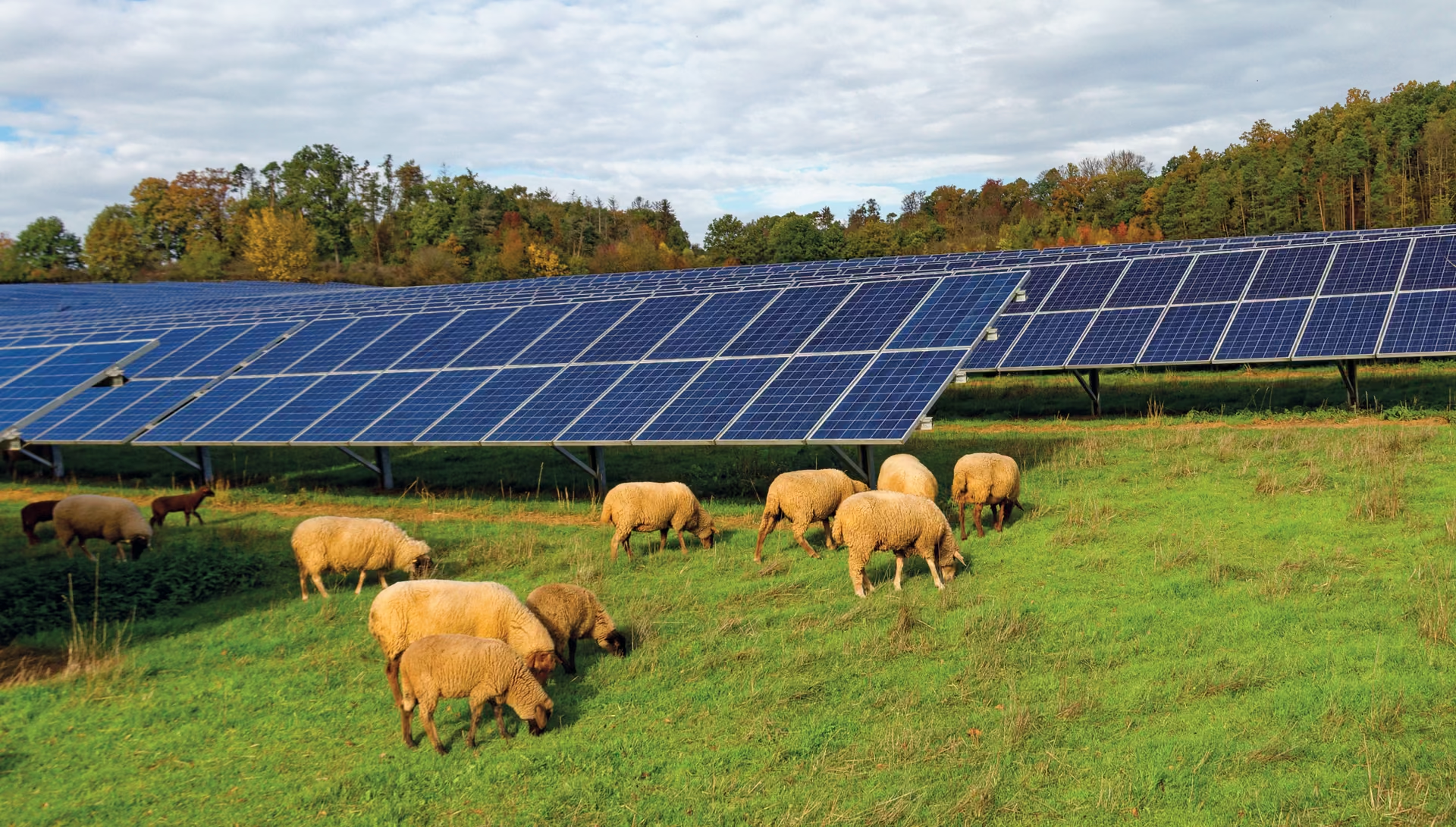
Solar farms are relatively low-lying and, as explained in our design commitments, we are proposing significant minimum distances between the taller elements of Longmarsh Green Energy and homes and other amenity sensitive receptors. We understand, however, that it would represent a change to what is currently there.
The EIA will examine the effect the project could have on the landscape and from a range of viewpoints around it, including potential glint and glare effects and/or radar impacts at RAF Marham. We are aiming to design the project to limit its visual impact on nearby residents and others such as users of public rights of way and will seek to agree mitigation with neighbouring residents to help screen the site where possible.

We will aim to minimise the use of local roads for both construction and operational traffic movements wherever possible, to limit impacts on local residents and communities. Construction routes and access points will be assessed, with feedback from local communities helping to identify roads, junctions and villages that need particular consideration.
Our final proposals in the DCO application will include controls on construction working hours, traffic routes that avoid specified local villages or settlements where practicable, and separation distances between noise-generating plant and homes and other amenity sensitive receptors.
Detailed assessment of noise from the operational proposals will be completed and measures to reduce impact, for example additional screening, will be included where needed.
There are no designated heritage assets within the project site area. The project will not result in any physical impacts on above-ground heritage assets and our design approach, including setbacks and landscape screening, is intended to reduce any effects on the broader “setting” of heritage assets located outside the site boundary.
Our assessments will identify areas of archaeological interest to ensure any significant assets are identified and protected prior to construction taking place. An archaeological mitigation strategy will be prepared and submitted as part of the DCO application.
We will assess potential effects related to flood risk and water as part of the EIA. We will work closely with the Environment Agency, Lead Local Flood Authority and the Internal Drainage Boards to ensure that any potential for flood risk is fully understood and appropriately managed.
The data centre is expected to use a sealed closed-loop cooling system, meaning there should be no significant impact on local water supply.
A full suite of ecology surveys is underway to identify any habitats or species that need to be specifically considered as part of the design process. The project design, through its approach to field and hedgerow planting, will seek to deliver a significant biodiversity net gain and we will also look to agree other ways to enhance ecology, for example by introducing bird and bat boxes.
We are not proposing to divert or close any of the limited number of public rights of way within the project site. While the project will need secure boundaries, we will also consider, and assess, local access to public rights of way and countryside amenity as well as the potential for improvements to connectivity between communities by introducing new permissive paths.
We understand that the use of agricultural land for solar farms is of interest. At the moment, solar farms occupy less than 0.1% of the UK’s land area. Scaling up solar in line with Government targets to decarbonise the electricity grid is expected to bring this up to just 0.3%.
The total project site area proposed, including cable routes, is a very small proportion of land in the East of England. We will assess agricultural land and confirm any identified impacts on food security to help inform our design. We will report on this in the ES.
- Air quality, where consideration of effects related to road traffic emissions and emissions from point-sources (such as backup generators) will be undertaken and measures identified to prevent or reduce effects.
- Carbon and climate change, including the reduction of greenhouse gas emissions due to the solar generation as well as climate resilience measures.
- Socio-economics, considering additional employment opportunities and economic benefits generated by the proposals.
- Cumulative effects, which comprise the combination or interaction of the potential effects with other developments in the area.